
2026 Top Trolley Elevator Types for Buyers to Compare
A Trolley Elevator can move loaded carts between floors, but the name covers several different equipment designs. Buyers may encounter enclosed goods lifts, open platform lifts, inclined systems, and guided vertical conveyors. Each handles a different mix of travel distance, load, and site conditions. The right comparison starts with the cart itself: its width, wheelbase, loaded weight, and turning clearance.
A compact platform may suit a back-of-house route with limited space. An enclosed lift can better protect goods and control access, while an inclined system may fit a sloped route. These are not interchangeable choices. A few centimeters matter. Door openings, pit depth, headroom, floor strength, and the path operators use can change what is practical. Buyers should also compare rated capacity, travel speed, operating frequency, loading method, control location, and maintenance access. Ask how the equipment behaves during a normal busy shift, not only during a demonstration.
Product names can be inconsistent across suppliers, so compare drawings and specifications rather than labels alone. Request a site assessment and confirm that the proposed unit matches the trolley dimensions and workflow. Check available documentation, service support, and applicable safety requirements for the installation location. No type is best for every building. A detail is easy to miss: operators may need space to position a cart safely, even when the lift platform seems large enough. This guide compares common types and the practical trade-offs buyers should examine before requesting a quote.
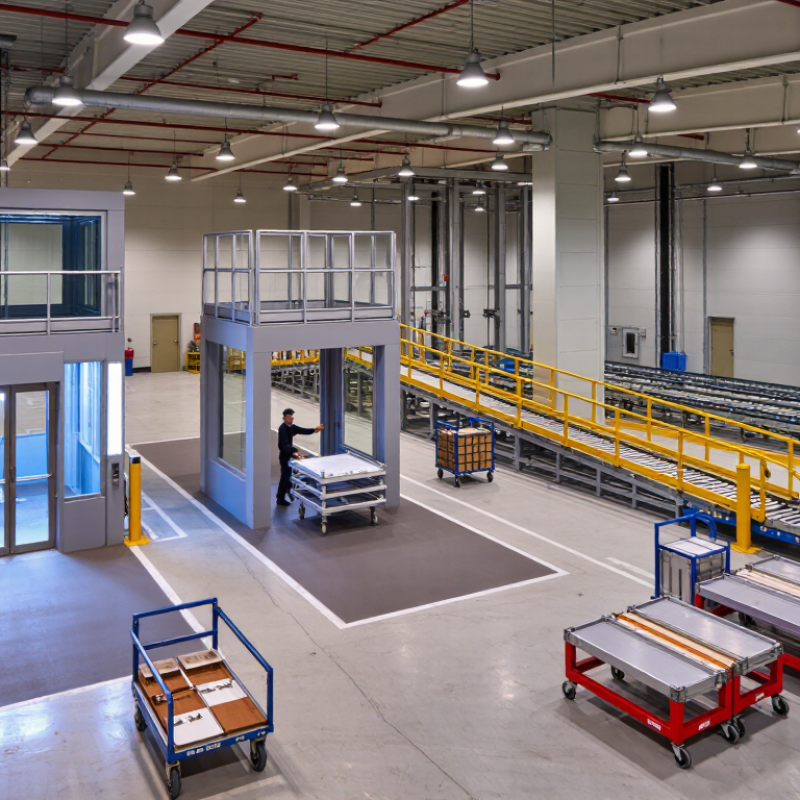
Table of Contents [Hide]
What a Trolley Elevator Is and How It Moves Loads
A trolley elevator is a powered lift that carries goods between levels, often with a wheeled trolley or cart on its platform. The trolley rolls onto the platform at floor level; the lift then travels vertically along guided rails or within a shaft. The term can describe different equipment, so buyers should check the design rather than assume every model works the same way.
Movement usually comes from an electric motor driving cables or chains, or from a hydraulic system pushing a lifting platform. At the destination, the platform aligns with the landing so workers can roll the cart off. A crate of parts may seem stable, but uneven weight can shift during travel. That detail is easy to overlook.
Check the rated capacity, platform dimensions, travel height, and how loads are secured. Gates and interlocks help prevent operation when an access point is open.
In real use, a few centimeters of misalignment can make a loaded trolley awkward to move. Verify the floor, doorway, and turning space at each stop before choosing a configuration.
Main Trolley Elevator Types Available in 2026
Trolley elevators generally move wheeled loads between floors or production levels. A reciprocating platform lift carries one trolley per trip. It suits low-to-medium traffic and simple, defined routes. Continuous vertical conveyors move several carriers in a repeating loop, making them better for steady flows between fixed levels. Inclined conveyor lifts handle gradual height changes, but need more floor space. Check trolley dimensions, wheel stops, rated load, and the platform’s clear opening before comparing models.
The 2024 MHI Annual Industry Report found that 55% of surveyed supply-chain professionals planned to increase investment in technology and innovation. That figure signals wider automation interest, not proof that a continuous lift fits every site.
For mixed loads, a platform lift may be easier to adapt; for repetitive transfers, continuous systems can reduce handling pauses. OSHA’s materials-handling guidance also stresses safe load limits and clear operating procedures.
Small details matter. A trolley that fits the platform may still snag at the landing if floor gaps or approach angles are overlooked. I would verify those conditions on-site; catalogue dimensions alone can be misleading.
How Trolley Elevator Designs Differ in Capacity and Operation
A trolley elevator’s rated load is only part of the comparison. Check usable platform dimensions, load distribution, travel height, and cycles per hour. A compact hydraulic goods lift often suits intermittent, low-rise moves. Its platform can handle unevenly shaped loads, but the layout must allow safe loading and unloading. A chain-driven platform lift may suit repeated trips between fixed levels. Confirm its duty rating and stopping accuracy against the real workload.
Continuous-loop trolley elevators move carriers along a set route, supporting steady transfers between defined pickup and discharge points. They can reduce manual handling, but offer less flexibility when trolley sizes or destinations vary. Small detail. A tall trolley may fit the rated weight yet strike a doorway or rack. Measure the complete load, including handles and overhang.
Automation plans also matter. MHI’s 2024 Annual Industry Report found that 55% of respondents planned to increase investment in supply-chain innovation and technology. That figure describes broader supply-chain investment, not elevator demand, but it signals why controls and system integration deserve scrutiny. Compare rated capacity with peak-hour throughput, not just average daily volume. Then ask for documented cycle limits and maintenance intervals; these details are easy to overlook.
Where Each Trolley Elevator Type Is Commonly Used
Warehouses often use vertical reciprocating conveyors (VRCs) to move loaded carts between fixed levels. They suit mezzanines and production areas where goods follow a repeatable route. A guarded platform can carry a trolley, but workers should not ride equipment designed only for freight. For multi-storey hotels, hospitals, and distribution buildings, a trolley-compatible freight elevator is more practical. Its enclosed car protects loads and allows staff to travel with them. Door width matters. A few centimeters can decide whether a loaded cart fits.
Shorter transfers call for different equipment. Scissor lifts commonly serve loading docks, stockrooms, and small workshops, especially where travel is limited. They offer direct access, though frequent, high-volume trips may make them a bottleneck. MHI’s 2024 Annual Industry Report found that 55% of surveyed supply-chain professionals expected to adopt robotics and automation within five years. That figure signals growing interest in automated material flow, not proof that one lift type suits every site. Measure cart dimensions, floor openings, travel height, and daily trips before comparing options. A tight layout changes the answer. Some facilities still choose too quickly. That deserves a second look.
Ratings are an indicative qualitative comparison of typical application fit, not measured market data. Dumbwaiters are generally intended for small items rather than full-size trolleys; vertical reciprocating conveyors (VRCs) are for goods only and not for carrying people.
Key Factors Buyers Should Compare Before Choosing a Trolley Elevator
A trolley elevator should match the loads and routes it will handle, not just fit the available space. Compare rated capacity with the heaviest loaded trolley, including occasional peaks. A small safety margin can help, but an oversized unit may cost more and occupy useful floor area. Measure platform width, door opening, and turning clearance with the actual trolley. A few centimeters can matter.
Check the lift height, travel speed, and expected trips per hour. A busy warehouse may need a different duty cycle from a small stockroom. Consider the power supply, installation space, and whether the building can support the equipment and its loads. Fit matters. Safety features should suit daily operation, including interlocks, emergency stops, and protection against unintended movement. Ask how routine inspections and repairs will be handled, and whether common parts are readily available.
The surrounding conditions deserve attention too. Dust, moisture, temperature changes, and frequent cleaning can affect equipment choices. Compare total operating costs, not only the purchase price; energy use and maintenance can add up. Request technical documents and confirm that stated capacities apply to your intended setup. I would avoid choosing from a specification sheet alone. A site check can reveal awkward approaches or trolley handles that catch on the entrance. Some details are easy to miss.
2026 Top Trolley Elevator Types for Buyers to Compare - Key Factors Buyers Should Compare Before Choosing a Trolley Elevator
Compare the lifting method, intended load, working environment, and safety features. Capacity, lift height, and operating details vary by model; confirm them against the manufacturer's specifications before purchase.
| Trolley Elevator Type | Lifting Method / Power | Typical Loads | Best Suited For | Advantages | Limitations to Consider | Key Buyer Checks |
|---|---|---|---|---|---|---|
| Manual hydraulic lifting trolley | Hand-operated hydraulic pump; typically raised by a foot pedal or hand control and lowered with a release valve. | Boxes, tools, components, and other palletized or platform-compatible loads. | Occasional lifting and short-distance movement where mains power is not required. | Simple operation, no battery charging, and generally straightforward maintenance. | Repeated pumping can be tiring; lifting speed and effort depend on the load and operator. | Rated capacity, minimum and maximum platform height, wheel type, brake arrangement, and lowering control. |
| Electric-hydraulic platform trolley | Battery-powered hydraulic pump raises and lowers the platform; the trolley may be pushed manually or powered for travel, depending on configuration. | Goods that need frequent height adjustment, including parts bins, workpieces, and packed materials. | Repeated lifting in assembly, packing, maintenance, or stock-handling tasks. | Reduces manual pumping and can help maintain a convenient working height. | Requires battery charging and routine checks of the battery, controls, and hydraulic system. | Battery type and runtime, charging arrangements, lift controls, emergency lowering, and whether travel is powered. |
| Manual stacker trolley | A hand-operated hydraulic or mechanical lifting system raises forks or a load platform along a mast. | Pallets, containers, and loads designed to be supported by forks or a compatible platform. | Moving and positioning loads at shelving, benches, or low-level storage locations. | Provides vertical lifting and load positioning without requiring an onboard drive motor. | Manual travel and pumping may be unsuitable for high-throughput work or long distances. | Fork dimensions and adjustability, mast clearance, lift height, turning space, and load center requirements. |
| Electric stacker trolley | Battery-powered lift; some models also provide powered travel, while others are pushed manually. | Palletized or fork-compatible loads for repeated stacking and retrieval. | Regular warehouse or production-floor handling where manual lifting effort should be reduced. | Powered lifting can make frequent elevation changes easier than manual pumping. | Needs charging, operator training, and sufficient aisle and turning clearance. | Powered versus manual travel, battery and charger, braking, mast visibility, aisle width, and stability at the intended lift height. |
| Scissor-lift trolley | A scissor linkage raises a flat platform; operation may be manual hydraulic or battery-powered hydraulic. | Stable loads that can be placed on a flat platform, such as components, cartons, and work materials. | Work-height adjustment, loading and unloading, and moving items between nearby work areas. | The broad platform supports a range of load shapes and can serve as a mobile work surface. | The lifting linkage creates pinch points; the platform may not suit pallet handling without an appropriate attachment. | Platform size, rated load, load distribution, guard or toe protection, wheel brakes, and safe lowering features. |
| Drum-lifting trolley | A drum-specific clamp, cradle, or gripping mechanism lifts and may tilt or rotate the drum; operation can be manual or powered. | Drums that match the trolley's specified size, material, and gripping method. | Moving, positioning, or dispensing drum contents in suitable industrial settings. | Purpose-designed handling can reduce the need to manually roll or lift drums. | Compatibility is specific to drum dimensions and construction; tilting or pouring adds spill and handling risks. | Drum diameter and type, full-load rating, grip security, tilt or rotation controls, and site spill-control requirements. |
| Roll-handling trolley | A cradle, spindle, or dedicated lifting attachment supports and raises cylindrical rolls; operation varies by design. | Paper, film, fabric, or other rolls compatible with the trolley's support arrangement. | Production and storage areas where rolls must be moved or loaded onto equipment. | Purpose-built supports can help control cylindrical loads during handling. | A general flat platform may not safely retain a roll; roll dimensions and core access can restrict compatibility. | Roll diameter, width, weight, core size, support geometry, retention method, and loading height. |
| Mobile goods lift | A mobile mast or lifting frame raises a platform or compatible attachment; available models use manual or powered lifting. | Equipment, materials, or components within the lift's rated capacity and attachment limits. | Intermittent vertical positioning tasks in maintenance, installation, or production areas. | A mobile frame can provide more vertical reach than a low-lift platform trolley, depending on the model. | May require stabilizers or a firm, level surface; it is not a passenger elevator unless specifically designed and approved for that use. | Rated load at the required height, stabilizer setup, floor conditions, attachment compatibility, and applicable local safety requirements. |