
China Top 10 XYZ Positioning System Manufacturers
China’s position in advanced manufacturing makes its precision-motion suppliers increasingly relevant to automation buyers. An Xyz Positioning System typically combines linear stages, motors, encoders, and motion controllers. Together, these components move a tool or workpiece along controlled axes. Applications range from inspection cameras and laser processing to laboratory instruments and semiconductor equipment. The label sounds simple. Performance is not.
The International Federation of Robotics’ World Robotics 2024 report recorded 276,288 industrial robot installations in China during 2023, representing 51% of global installations. This figure describes robot installations, not XYZ-stage sales. It does, however, show the scale of China’s automation ecosystem and its potential demand for precise motion components. Comparing manufacturers requires more than reading advertised accuracy. Buyers should examine repeatability, payload, travel range, speed, control compatibility, calibration methods, and after-sales support. A stage rated for a light optical sensor may not suit a heavier inspection assembly. Nor do identical specifications always reflect identical test conditions.
This overview introduces ten Chinese manufacturers and the capabilities they report for their positioning products. It is a starting point, not a laboratory ranking. Public datasheets can omit useful details, and terminology varies between suppliers. Confirm performance against your own load, environment, and integration requirements before making a shortlist.
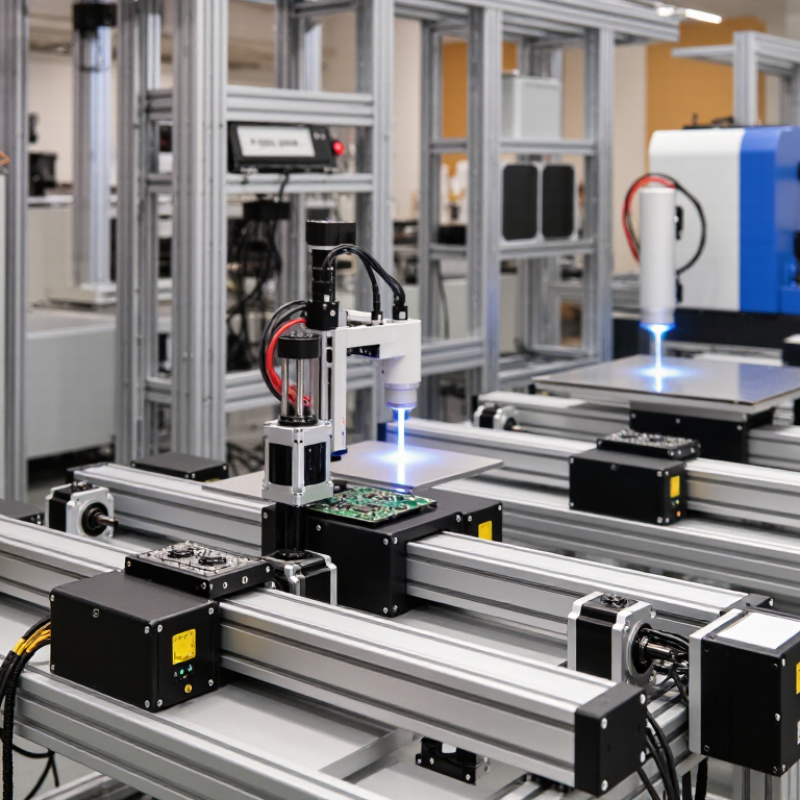
Table of Contents [Hide]
Understanding XYZ Positioning Systems and Their Core Technologies
An XYZ positioning system moves a tool or sample along three perpendicular axes. Each axis combines a drive, guideway, position sensor, and controller. Servo motors turn ball screws or drive linear stages; encoders report movement back to the controller. This feedback loop corrects errors while the system moves. Simple in concept. Demanding in practice. Motor resolution alone does not determine accuracy: guideway straightness, backlash, payload, vibration, and temperature also matter.
The International Federation of Robotics reported 4,281,585 industrial robots operating worldwide in 2023, a 10% increase from 2022 (World Robotics 2024). This wider automation trend raises the value of repeatable positioning in inspection, assembly, and laboratory equipment. Core technologies vary by task: optical encoders provide fine feedback, linear motors avoid screw-related backlash, and interferometric measurement can support precise calibration. Yet “precision” figures are meaningful only when test conditions, travel distance, and load are stated. A specification without these details can mislead.
Tips: Check repeatability under the real payload, not just an unloaded bench test. Warm the stage before measurement, record temperature, and verify calibration periodically. Even careful setups drift.
China’s XYZ Positioning System Manufacturing Landscape
China’s XYZ positioning-system manufacturing landscape is shaped by automation demand and a layered supply chain. A typical system combines a rigid frame, linear guides, ball screws or direct drives, servo controls, encoders, and motion software. Chinese suppliers span component specialists and integrators serving electronics assembly, inspection, laser processing, and laboratory automation. The useful distinction is not simply “high-end” versus “low-cost.” Repeatability, payload, travel, settling time, and service support determine fit.
Demand is supported by industrial automation growth. The International Federation of Robotics’ World Robotics 2024 report recorded 276,288 new industrial robot installations in China in 2023, about 51% of global installations. This is a market indicator, not a direct count of XYZ positioning systems. Buyers should verify specifications through application trials and independent measurement. Resolution is not the same as positioning accuracy. That detail is often missed.
Tips: Ask for bidirectional repeatability, straightness, backlash, thermal drift, and load-test results under your actual duty cycle. Check calibration records and spare-part lead times. Not enough? Request warm-up data, too. A compact stage can drift after hours of use.
China Top 10 XYZ Positioning System Manufacturers - China’s XYZ Positioning System Manufacturing Landscape
The profiles below describe common supplier capability categories in China’s XYZ positioning market. They are illustrative, not a company ranking; no company or brand names are shown. Performance figures are indicative and depend on equipment, setup, environment, and test conditions.
| No. | Supplier Capability Profile | Positioning Technology | Typical Working Range / Accuracy | Common Applications | Typical Integration |
|---|---|---|---|---|---|
| 1 | Laser tracker systems | Laser interferometry and angular measurement | Large-volume measurement over distances of several to tens of metres; uncertainty can be in the tens-of-micrometres class under specified conditions. | Aircraft assembly, machine-tool alignment, large-part inspection | Metrology software, tooling targets, factory quality systems |
| 2 | Coordinate measuring machine (CMM) systems | Contact probing or optical probing on a controlled machine structure | From benchtop parts to metre-scale components; accuracy ranges from a few micrometres to tens of micrometres depending on machine size and class. | Precision machining, automotive components, dimensional inspection | CAD comparison, probing software, temperature-controlled inspection rooms |
| 3 | Structured-light 3D scanning systems | Projected light patterns and stereo-camera reconstruction | Close-range scanning; system specifications commonly fall in the hundredths-to-tenths-of-a-millimetre range, depending on field of view and setup. | Reverse engineering, mould inspection, product development | Point-cloud processing, CAD inspection, handheld or tripod workflows |
| 4 | Industrial photogrammetry systems | Multi-image camera measurement with coded targets or feature matching | Suitable for large objects and workspaces; achievable accuracy depends on camera geometry, scale, target layout, and calibration. | Large structures, vehicle bodies, aerospace and energy equipment | Scale bars, measurement targets, 3D inspection software |
| 5 | GNSS RTK positioning systems | Satellite navigation with real-time carrier-phase corrections | Typically centimetre-level horizontal positioning in suitable conditions; performance degrades with obstructions, multipath, or poor correction links. | Surveying, construction layout, agriculture, outdoor asset positioning | Correction services, surveying controllers, geographic information systems |
| 6 | Total station and robotic surveying systems | Electronic angle measurement and electronic distance measurement | Range varies by instrument and target; common distance specifications are around 1–2 mm plus a parts-per-million term, with angular classes commonly measured in arcseconds. | Construction surveying, civil engineering, building layout | Prisms, robotic tracking, survey data collectors, site-control networks |
| 7 | UWB indoor positioning systems | Ultra-wideband radio ranging between anchors and mobile tags | Often decimetre-level in practical indoor deployments; accuracy varies with anchor geometry, obstructions, and multipath. | Warehouse tracking, personnel safety, indoor asset location | Fixed anchors, wearable or asset tags, warehouse and location platforms |
| 8 | Laser interferometer and displacement measurement systems | Laser wavelength-based displacement measurement | High-resolution displacement measurement, including sub-micrometre resolution in suitable configurations; overall accuracy depends on alignment and environmental compensation. | Machine-tool calibration, stage testing, precision motion analysis | Environmental sensors, linear stages, calibration and compensation software |
| 9 | Laser triangulation and displacement sensor systems | Optical triangulation for non-contact distance measurement | Short-range measurement; resolutions from micrometres to finer or coarser levels are available depending on sensor range and target surface. | Thickness checks, dimensional inspection, production-line measurement | PLC and industrial network interfaces, fixtures, automated inspection cells |
| 10 | Robot and motion-positioning integration systems | Encoders, servo control, kinematic calibration, and external metrology feedback | Positioning performance is application-specific; repeatability and absolute accuracy differ and depend on robot structure, payload, calibration, and working volume. | Automated assembly, dispensing, material handling, robotic inspection | Robot controllers, motion-control software, safety systems, external measurement devices |
Key Criteria for Evaluating Leading Manufacturers
When comparing China’s XYZ positioning system manufacturers, look beyond headline accuracy figures. A stated resolution of 0.01 mm does not prove repeatable performance across the full working volume. Ask for test data showing errors at the center and edges, under realistic loads and operating temperatures. Test the details. Check repeatability, update rate, drift, and settling time; a system that reaches a target quickly but oscillates may slow production. Confirm which calibration method and measurement conditions produced the published results.
Physical fit matters too. Review the usable travel, mounting requirements, cable routing, and protection against dust or vibration. Confirm that the controller supports your existing interfaces and that setup instructions include troubleshooting steps. Request a sample inspection report, calibration records, and a clear description of technical support response times. Compare warranty terms and spare-part availability, not just purchase price. A useful evaluation includes a trial using your own fixture and representative workpieces. No single score tells the whole story, and even a careful trial can miss changes that appear after months of use. Some specifications may also be difficult to compare when manufacturers test under different conditions. Ask for clarification in writing.
Profiles of Ten Notable Chinese XYZ Positioning System Manufacturers
Chinese XYZ positioning manufacturers work across linear stages, gantry platforms, motion-control integration, and custom automation. Their systems combine X, Y, and Z movement with motors, guides, and feedback devices. Accuracy depends on the full assembly, not one component. Small alignment errors can shift a camera’s measurement or a tool’s path.
The ten profiles can be compared by specialization: precision stages, compact modules, large-workspace gantries, optical-inspection motion, semiconductor handling, laboratory automation, heavy-load platforms, encoder integration, custom-machine engineering, and calibration services. These distinctions help buyers match equipment to payload, travel range, speed, and repeatability needs. Not interchangeable. China’s manufacturing demand provides useful context: the International Federation of Robotics’ World Robotics 2024 report recorded 276,288 industrial robot installations in China during 2023, about 51% of global installations. That figure describes robots, not XYZ systems, but it signals a substantial automation ecosystem.
When reviewing a supplier profile, check stated repeatability separately from resolution, and request test conditions, load limits, and maintenance guidance. A polished specification sheet is not enough. Some public profiles omit comparable test methods, making direct ranking uncertain. Treat the ten profiles as a practical map of capabilities, not a verified league table; confirm performance with application-specific trials and documented measurements.
Comparing Manufacturer Capabilities, Applications, and Product Strengths
Comparing the top 10 XYZ positioning system manufacturers means looking beyond headline accuracy. A compact stage may suit optical inspection, while a long-travel platform may serve machine tools or automated handling. Check travel range, repeatability, payload, speed, and settling time against the actual task. A system that performs well with a light sensor may behave differently under a heavier fixture.
Manufacturers also differ in integration depth. Some supply stages and controllers as a matched package; others offer modular parts for custom automation. Look for clear motion-control documentation, encoder options, cable routing details, and stated operating temperatures. In a lab, smooth movement and low vibration can matter more than peak speed. On a production line, service access and replacement-part availability may carry greater weight. Small details count.
A spec sheet can still mislead. Ask for test conditions, not just the best number, and compare measurements made with similar loads and travel distances. Request a sample run or application review when practical. This takes time. Yet it can reveal backlash, settling delays, or mounting issues before installation. Manufacturer strengths are real, but the best fit depends on the payload, environment, accuracy target, and support required. Some projects also change after testing; the first selection is not always the final one.