


Design and development by Raincastle Communications.

Choosing a Maize Flour Mill Machine is a production decision, not just a purchase. The right mill should match your maize supply, target flour texture, daily output, power access, and maintenance skills. A machine that looks impressive on a showroom floor may struggle with damp grain, voltage fluctuations, or a shortage of spare parts. Small details matter: sieve changes, bearing temperature, dust control, and how quickly operators can clean the grinding chamber.
The scale of demand makes careful selection worthwhile. FAOSTAT’s crop-production database records more than one billion tonnes of maize produced globally each year, although harvest volumes and quality vary by region and season. USDA Foreign Agricultural Service estimates also track maize production, trade, and stocks, helping buyers understand the market context behind equipment investments. These reports describe the crop, not the performance of any particular mill. Test claims with a sample of your own grain. Ideally, measure flour fineness, throughput, energy use, and product loss during a supervised trial.
Agricultural scientist Norman Borlaug warned, “You can’t build a peaceful world on empty stomachs and human misery.” His words are not a machine-selection rule, but they underline why dependable food processing matters. Ask suppliers for verified capacity figures, a clear warranty, installation support, and references from comparable mills. Look closely. A low purchase price can conceal expensive downtime. And yes, even a well-chosen machine needs skilled operators and routine care. There is no perfect mill for every business; the best choice is the one whose real performance fits your grain, budget, and growth plans.
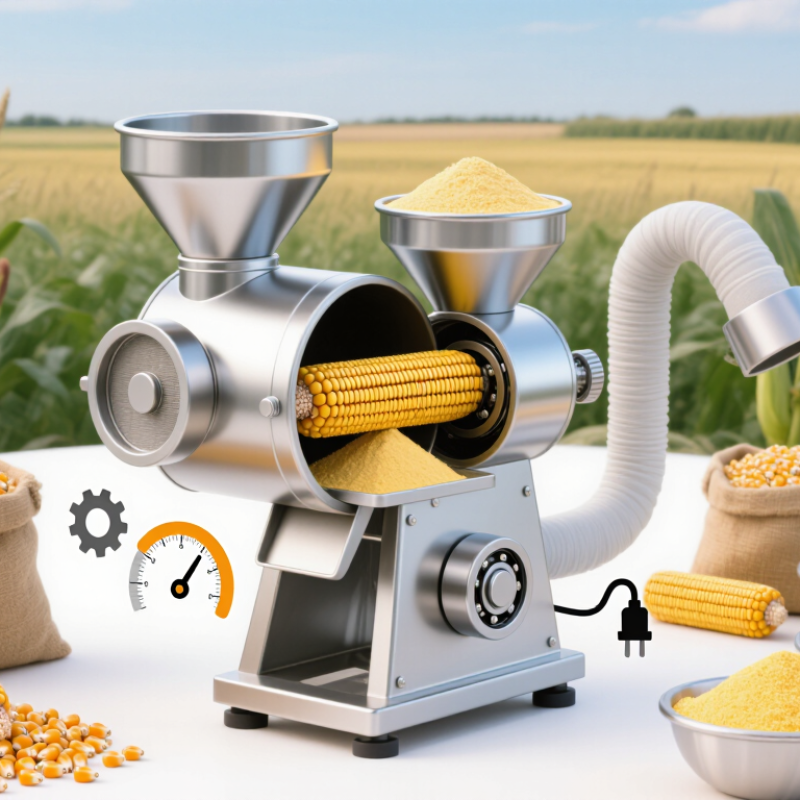
How to Choose the Best Maize Flour Mill Machine?
Understanding the Types and Functions of Maize Flour Mill Machines
Maize flour mills differ in how they break kernels and control texture. Hammer mills use fast-moving hammers to produce meal or flour, while plate mills grind between adjustable surfaces. Roller mills use staged, even pressure and suit operations needing more consistent particle sizes. Some lines add dehulling or degermination before grinding. These steps remove parts of the kernel and affect flour color, taste, and shelf life.
The right setup depends on the product, not just the motor size. FAO’s World Food and Agriculture: Statistical Yearbook 2023 reports global maize production of about 1.16 billion tonnes in 2022, reflecting the crop’s broad role in food systems. That scale does not mean every mill needs industrial capacity. A village processor may value simple cleaning and screen changes; a larger plant may need calibrated rollers, aspiration, and multiple sieves. Look for clear information on throughput, power use, spare parts, and the particle size each machine can achieve.
A mistake is choosing by output claims alone. Check kernel moisture and feed consistency, too. They change milling performance. Ask to see flour from a test run, then inspect its texture and temperature. Small detail, big difference. I would still verify the stated capacity with the actual maize variety and operating conditions; published figures can be optimistic.
| Machine type | Main function and working principle | Typical flour or meal characteristics | Best suited for | Key advantages | Points to consider |
|---|---|---|---|---|---|
| Hammer mill | Rotating hammers break kernels by impact. A screen controls the size of particles that can leave the grinding chamber. | Can produce coarse meal or finer flour, depending on the screen, feed rate, and operating conditions. Whole-kernel milling generally retains the bran and germ. | Small and medium mills, animal-feed preparation, and general-purpose whole-maize meal production. | Versatile, relatively simple to operate, and suitable for a range of grain products. | Fine screens can reduce throughput and increase heat and wear. Screen condition, dust control, and safe operation need attention. |
| Plate or disc mill | Grain is crushed and sheared between two grooved plates or discs. The gap between the grinding surfaces affects the particle size. | Typically produces meal or flour with a practical range of particle sizes; uniformity depends on plate design, adjustment, and grain condition. | Small-scale processing and users who need a mechanically straightforward mill with adjustable settings. | Compact design and simple adjustment make it accessible for smaller operations. | Plates wear over time and may need replacement or adjustment. Check local service access and spare-part availability. |
| Roller mill | Fluted or smooth rolls progressively crack, flatten, or grind the maize. Commercial plants commonly use multiple roll passes and sifting stages. | Can produce more controlled fractions and a more consistent particle size. Refined flour production usually involves additional separation and processing steps. | Medium- to large-scale operations seeking controlled, repeatable milling and the ability to separate different fractions. | Offers good process control and can support staged milling and sifting. | A complete roller-milling line can require more equipment, setup, space, and operator skill than a single-stage mill. |
| Pin mill | High-speed rows of pins reduce particle size through repeated impact and particle-to-particle interaction. | Often used for fine grinding or size reduction after an initial milling stage; the final result depends on the design and settings. | Applications that need finer powder or a secondary grinding step. | Can achieve fine particle sizes in a compact grinding stage. | Fine grinding can generate heat and dust. Confirm that the mill is designed for the intended feed size and duty cycle. |
| Stone mill | Grain is ground between millstones, with particle size influenced by stone spacing, surface pattern, and feed rate. | Often associated with whole-grain meal and a coarser or less uniform texture than highly controlled multi-pass systems. | Small-batch production and products where a traditional milling method or whole-grain character is desired. | Straightforward process and suitable for specialty or small-batch products. | Capacity and particle-size consistency depend on the mill design and stone condition; stones require inspection and maintenance. |
Selection note: Actual capacity, power use, and flour fineness vary with maize variety, moisture content, feed preparation, screen or roll settings, motor power, and operating conditions. Compare machines using the same stated product, target fineness, and test conditions. For food production, also consider cleaning, sieving, dust control, food-contact materials, and access to maintenance.
Design and development by Raincastle Communications.
 Customer Support
 Request Sample
 Contact