
How to Choose the Best Outdoor Trampoline in 2026?
Choosing an Outdoor Trampoline in 2026 means looking beyond its size or price. A safe, enjoyable fit depends on who will use it, how much space is available, and the conditions in your yard. Measure the intended area carefully, including room around the frame, and check the maker’s guidance for clearance and setup. A trampoline that looks compact online can feel large beside a fence or patio. That matters.
Start by comparing weight limits, frame construction, jumping surface, springs or spring-free design, and enclosure details. Check that the product instructions clearly explain assembly, anchoring, and routine inspection. Wind, rain, and prolonged sun can affect outdoor equipment, so review care recommendations and consider whether a cover or seasonal storage is practical. No single feature guarantees safety. Adult supervision, sensible use, and a suitable landing area remain important.
This guide will help you weigh these details against your budget, available space, and family’s needs. It will also explain what to look for in warranties, replacement parts, and customer support, rather than treating a long warranty as proof of quality. Product descriptions can sound reassuring; still, specifications and clear instructions deserve a closer read. There may be trade-offs. A larger model can offer more room, but it also needs more clearance and careful placement. Use the following criteria to make a considered choice, and revisit them before buying.
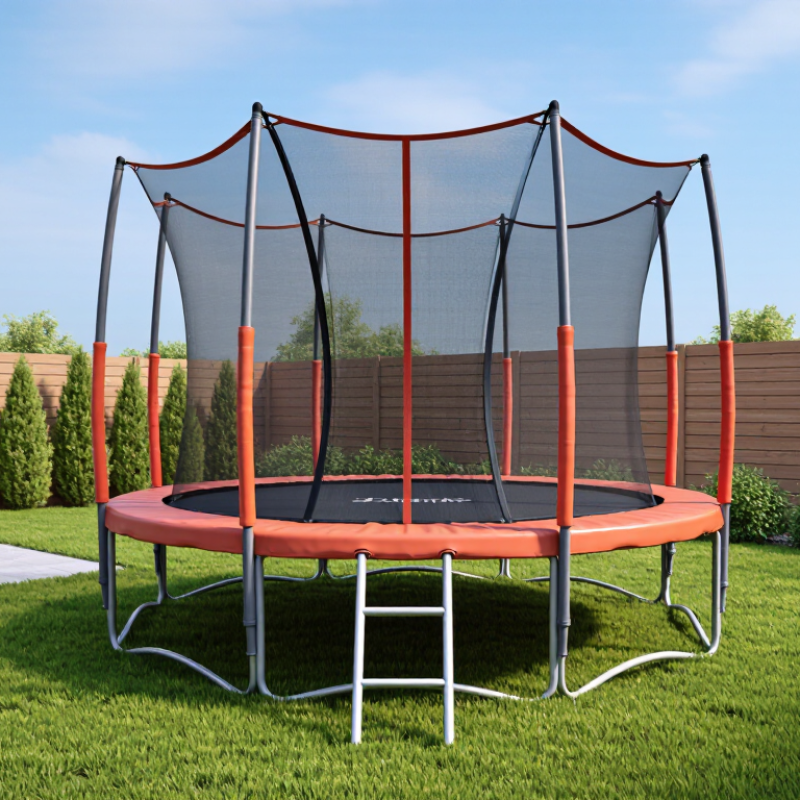
Table of Contents [Hide]
Define User Needs, Yard Space, and Trampoline Size
Before comparing trampoline sizes, decide who will use it and how often. One child jumping alone needs less room than siblings taking turns, but the product’s age and weight limits still matter. Check those limits rather than guessing from the frame size. A larger model can feel roomy, yet it also takes up more yard space.
Measure the usable area, not just the patch of lawn that looks open. Include the frame, enclosure poles, and the clearance required in the manufacturer’s setup instructions. Look above, too: tree branches, roof edges, and overhead wires can make a seemingly perfect spot unsuitable. Keep the location level, and check that the ground drains well after rain. A muddy corner is not a good bargain.
I still find it easy to underestimate the footprint. Mark the proposed area with a garden hose or string, then walk around it and check nearby gates, paths, and play equipment. Leave enough space to move safely around the trampoline. If the yard is narrow, a smaller model may fit better, even if the jumping surface feels less generous. Measure twice. Choose based on the users and the actual available space, not the biggest size you can squeeze in.
Compare Frame, Jumping Mat, Springs, and Weather-Resistance Ratings
How to Choose the Best Outdoor Trampoline in 2026? Compare the frame, jumping mat, springs, and weather-resistance ratings before buying.
A sturdy frame should have corrosion-resistant steel, secure joints, and legs that sit evenly on level ground. Check welds and connection points for rough edges or visible gaps. They matter.
The jumping mat should feel tightly woven, with reinforced stitching around its attachment points. Ask whether its fabric has documented UV-resistance testing; sun exposure can weaken materials over time.
For springs, compare their length, coating, and attachment design, not just the total count. More springs do not automatically mean a better bounce. Weather-resistance ratings are useful only when you know what was tested, such as UV exposure or corrosion. Follow the care instructions, and inspect the frame and mat after rough weather.
Tips: Measure your yard, then check the trampoline’s full clearance needs. Confirm that the spring cover stays in place during use. If strong winds are common, use the anchoring method specified in the manual; an anchor is not a substitute for taking it down when conditions exceed its guidance. Be honest about maintenance: a quick inspection may reveal wear, but it cannot predict every failure.
Check Compliance with ASTM F381 and ASTM F2225 Safety Standards
When choosing an outdoor trampoline in 2026, check whether its documentation refers to ASTM F381 and ASTM F2225. F381 addresses trampoline design, construction, performance, and labeling. F2225 covers enclosure systems. One standard does not replace the other. A frame may meet one specification while its enclosure needs separate evaluation.
Ask for test documentation tied to the exact model, not a general statement about a product range. ASTM publishes standards; it does not approve individual trampolines. Check the standard editions listed and whether an independent laboratory tested the product. Details matter. Look for clear assembly instructions, weight limits, warning labels, and guidance on anchoring the frame. If a seller cannot provide specific records, treat that as a reason to ask more questions.
A compliant design still needs careful setup and regular checks. Set the trampoline on level ground, secure it as instructed, and inspect the net, seams, springs, and frame after storms or heavy use. Gaps near the enclosure entrance can be easy to miss. Standards reduce certain risks; they cannot prevent every fall or injury. I would not rely on a badge or a neat-looking net alone. Check the paperwork, then check the actual unit.
How to Choose the Best Outdoor Trampoline in 2026? — Check Compliance with ASTM F381 and ASTM F2225 Safety Standards
| Selection Dimension | What to Check | Practical Guidance | Questions or Evidence to Request |
|---|---|---|---|
| ASTM F381 — trampoline | ASTM F381 is the Standard Safety Specification for Components, Assembly, and Use of a Consumer Trampoline. It addresses trampoline-related safety requirements and use information. | Look for clear, product-specific information stating that the trampoline was designed or tested to the applicable edition of ASTM F381. Do not treat a general “meets safety standards” statement as proof by itself. | Ask for the standard edition, test or conformity documentation, and the model covered by the documentation. |
| ASTM F2225 — enclosure | ASTM F2225 is the Standard Safety Specification for Components, Assembly, and Use of a Trampoline Enclosure. | If the trampoline includes an enclosure, check that the enclosure is intended for that specific frame and that its safety information refers to ASTM F2225. An enclosure is not a substitute for supervision or safe use. | Confirm whether the enclosure is included, compatible with the selected model, and covered by the stated testing or conformity information. |
| Standards documentation | The exact model, components, and applicable standard editions should be identifiable in product documents. | Prefer traceable test reports or a clearly described conformity assessment over vague claims. ASTM publishes standards; a claim of compliance does not necessarily mean ASTM has certified the product. | Request the report or declaration, issuing laboratory or assessor, test date, and model or configuration tested. |
| Available yard space | Measure the intended site and compare it with the assembled trampoline dimensions and the clearance specified in the instructions. | Choose a level, open location away from structures, trees, fences, overhead hazards, and other obstacles. Follow the product instructions and local requirements for clearance; there is no single clearance figure that suits every installation. | Check the assembled diameter or footprint, overall height, and required side and overhead clearances in the manual. |
| User capacity and supervision | Check the manufacturer’s maximum user weight and age guidance, and whether the intended users can follow the safety instructions. | Allow one jumper at a time, supervise children, and follow the manual’s restrictions. Multiple jumpers increase collision risk, especially when users differ in size. | Verify the stated weight limit and age guidance on the product label and in the instructions; do not infer a safe limit from trampoline diameter alone. |
| Frame and leg stability | Inspect the frame construction, connection points, leg layout, finish, and any specified anchoring method. | The frame should sit level and be assembled exactly as directed. Outdoor wind can move or overturn equipment; use anchoring or other wind precautions only as specified by the manufacturer. | Check assembly instructions, recommended anchors, corrosion-care guidance, and replacement-part availability. |
| Enclosure and entry closure | Check net attachment, entry closure, fit with the jumping surface, and the condition of poles and padding. | The enclosure should be installed as instructed and its entry closed during use. Regularly inspect it for tears, loose connections, gaps, and damaged padding. | Confirm the enclosure’s compatibility and whether replacement netting, poles, and pads are available for the exact model. |
| Springs, mat, and padding | Look for securely attached springs, intact stitching, a sound jumping mat, and padding that covers the spring area as designed. | Do not use the trampoline if parts are missing, torn, stretched, loose, or damaged. Replace parts only with components specified for the model. | Review the inspection schedule, maintenance instructions, warranty terms, and availability of model-specific replacement parts. |
| Assembly and instructions | The package should include complete assembly instructions, warnings, use rules, inspection guidance, and a parts list. | Assemble on a level surface using the supplied instructions and all specified parts. Keep instructions available for future inspections and repairs. | Check that instructions are readable and specific to the model, and that the required tools and parts are identified. |
| Safe-use rules | The manual should explain safe entry and exit, prohibited activities, supervision, and the need to inspect before use. | Follow the warnings. Avoid flips and other stunts unless specifically taught and supervised by a qualified professional; do not jump onto or off the trampoline. | Read all warnings before purchase and confirm they can be followed by every intended user. |
| Outdoor exposure and upkeep | Review care instructions for rain, moisture, sunlight, snow, and wind, along with recommendations for covering or storing components. | Outdoor exposure can wear materials over time. Inspect the frame, mat, springs, net, and pads before use and after severe weather; follow the manual for weather-related precautions. | Check the cleaning and storage instructions, expected maintenance, and any limits on leaving the trampoline assembled outdoors. |
| Overall buying decision | Compare documented standards claims, fit for the site, stated user limits, enclosure compatibility, instructions, and support for parts and maintenance. | Choose a model that fits the available space and intended users, has clear safety documentation, and can be maintained. ASTM conformity can inform a decision but cannot eliminate all risk of injury. | Before buying, verify model-specific documentation and read the complete manual. Check applicable local rules and recall information as well. |
Safety note: ASTM F381 applies to consumer trampolines, while ASTM F2225 applies to trampoline enclosures. Always follow the product’s warnings, assembly instructions, and maintenance guidance. Standards compliance does not guarantee that injuries will not occur.
Match Weight Limits to Manufacturer Ratings and AAP’s One-Jumper Rule
How to Choose the Best Outdoor Trampoline in 2026?
When comparing outdoor trampolines, check the manufacturer’s maximum user-weight rating in the product manual. Treat it as a limit, not a target: a higher rating does not make group jumping safe. The frame, mat, springs, and enclosure also need regular checks for wear, loose connections, and damage.
Follow the American Academy of Pediatrics’ one-jumper rule. Its 2012 clinical report cited research finding that about 75% of trampoline injuries occurred when multiple people were jumping. Smaller jumpers faced greater injury risk when sharing the mat with heavier jumpers. That figure comes from earlier research, not a guarantee of any individual outcome, but the practical advice remains clear. One jumper at a time. It is tempting to read a generous weight rating as permission to take turns less carefully. It isn’t.
Tips: Before each session, confirm the jumper is within the stated weight limit, clear toys and wet leaves from the mat, and check that the enclosure closes securely. Keep a close eye on children, especially near the edge. A checklist can help, though it cannot catch every problem. Stop use if parts are damaged, and follow the manual’s inspection and maintenance instructions.
Outdoor Trampoline Weight Limits: Match the Rating to the Jumper
Example weight-limit values shown in pounds and kilograms. Ratings vary by model; always follow the specific trampoline manufacturer’s stated limit.
Choose a trampoline whose stated weight limit is at least the jumper’s weight, and never exceed that limit. The American Academy of Pediatrics recommends allowing only one jumper at a time; multiple jumpers increase collision and injury risk.
Evaluate Anchoring, Safety-Net Design, and Replacement-Part Availability
An outdoor trampoline needs a secure anchoring plan, not just sturdy-looking legs. Check whether the frame has dedicated anchor points and whether compatible stakes or straps are available. Match the anchoring method to your yard’s soil; loose, sandy ground may need a different approach from firm turf. Follow the maker’s wind guidance, and inspect anchors after heavy rain. No setup is perfect. The U.S. Consumer Product Safety Commission estimated 104,691 trampoline-related emergency-room injuries in 2014, based on its NEISS data. That older figure is not a current-year forecast, but it shows why stable setup and careful use matter.
Inspect the safety net before buying. Look for a fully enclosed jumping area, secure entry closure, and net connections that do not leave wide gaps near the mat. ASTM F2225 covers trampoline enclosures, while ASTM F381 addresses consumer trampoline safety specifications; check product documentation rather than assuming compliance. Small details count. Ask whether replacement nets, springs, pads, and frame parts can be ordered individually, and confirm they fit the exact model and size. A low purchase price can be misleading if one torn net makes the whole unit unusable. I would also check how long parts are expected to remain available. That detail is easy to overlook, and it may change the better choice.