
contact-button

2026 Top 7th Axis Robot Suppliers for Global Buyers

A 7Th Axis Robot can turn a fixed industrial arm into a longer-reaching workcell partner. Mounted on a linear track, the robot can serve several stations, load machines, or move along a production line. The track itself is only part of the decision. Buyers must also examine payload, travel length, positioning accuracy, controls integration, safety design, service access, and spare-parts availability. Small details matter. A cable carrier that restricts movement or a difficult controller interface can complicate an otherwise promising installation.

Robotics expert Rodney Brooks wrote, “The world is its own best model.” His observation concerns robotics broadly, not seventh-axis supplier selection specifically. Still, it offers a useful reminder: evaluate equipment in the conditions where it must work. Ask suppliers for documented specifications, integration guidance, and references for comparable applications. Check how the rail handles the robot’s load during acceleration, and whether the proposed layout leaves room for maintenance. A polished brochure is not enough.

This guide compares seven suppliers for global buyers, focusing on practical fit rather than rankings alone. Availability, local support, and compatibility can vary by region and project. No shortlist is perfect. Some published specifications may not reveal the full integration effort, so confirm critical details directly with each supplier. A careful comparison can reduce surprises, though it cannot remove every one.
2026 Top 7th Axis Robot Suppliers for Global Buyers

What Is a 7th Axis Robot and How Does It Extend a Robot’s Reach?

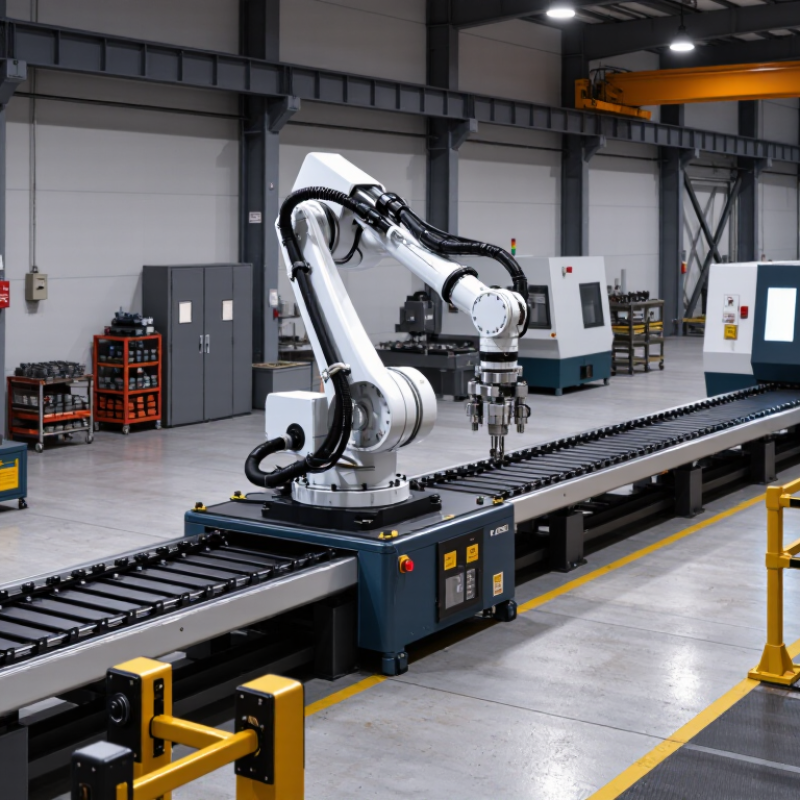
A 7th axis is a powered linear track that carries an industrial robot along the floor, wall, or ceiling. The robot’s six joints still handle rotation and positioning; the added axis moves its base to reach more stations. Think of a welding arm sliding between two fixtures, or a machine-tending robot serving several presses without needing a separate robot at each one. That changes the geometry.

The extra travel is not simply extra reach. Engineers must coordinate the rail with the robot, workpiece, cables, safety zones, and cycle timing. A longer track can add coverage, but it may also bring more setup work and motion-planning complexity. The trade-off is easy to underestimate. In practice, the useful reach depends on payload, speed, accuracy, and where the rail can be installed—not just its length.

The International Federation of Robotics’ World Robotics 2024 report recorded 4.28 million industrial robots operating worldwide in 2023, with 541,302 new installations that year. Those figures show the scale of industrial automation, not demand for seventh-axis systems specifically. That distinction matters. Buyers should check reach across the full travel path, stopping accuracy, floor loading, and maintenance access before specifying a track. A neat simulation can still miss a real cable snag.

How to Evaluate 7th Axis Suppliers for Global Projects

Global buyers should assess a seventh-axis supplier by the whole cell, not rail travel alone. Define payload, usable stroke, travel speed, acceleration, repeatability, and duty cycle for the actual robot and tool. A long rail may look impressive, yet cable routing, floor flatness, and stopping distance can limit useful performance. Request load calculations and a witnessed acceptance test using your own payload.

Check how the supplier validates accuracy across the full travel. Ask for measurement methods, test conditions, and results at several carriage positions, not only near the center.

The International Federation of Robotics reported 541,302 industrial robots installed worldwide in 2023, in World Robotics 2024. That figure reflects a broad automation market, not seventh-axis demand, but it underscores why integration and service capacity matter across regions.

For global projects, confirm spare-parts availability, response times, documentation languages, and support during commissioning. Ask who owns troubleshooting when the rail, robot, and control system come from different vendors. Get a clear interface list before purchase. Small omissions matter. A supplier’s repeatability figure may not predict performance after installation, especially when foundations or cable carriers differ. I would treat published specifications as a starting point, then verify them under site conditions.

Seven Leading 7th Axis Robot Suppliers for Global Buyers in 2026

In 2026, global buyers can compare seven leading 7th axis robot supplier profiles: long-stroke rail specialists, modular track manufacturers, heavy-payload system builders, compact-cell designers, custom-machining providers, turnkey integrators, and regional service partners. Each serves different production needs. A rail for welding may need heat protection and stable cable routing, while a packing line may prioritize quick installation and repeatable positioning. Fit matters most.

Before requesting a quote, define robot payload, travel length, target speed, mounting orientation, and floor conditions. Ask suppliers for load calculations, positioning data, installation drawings, and maintenance intervals. Check how they handle rail alignment, lubrication, cable carriers, guarding, and communication with the robot controller. These details affect uptime more than a polished brochure. A useful supplier should explain trade-offs in plain terms and provide realistic commissioning requirements.

For international projects, review spare-part availability, technical support hours, documentation quality, and local installation capability. Request references from applications with similar duty cycles, not just similar robot models. A long axis can look simple on paper. It may still need careful foundation work and alignment. Buyers sometimes focus too heavily on initial price; that is understandable, but not always wise. Compare lifecycle costs and clarify what the quotation excludes before choosing a partner.

2026 Top 7th Axis Robot Suppliers for Global Buyers

Robot axis count by configuration

A typical articulated industrial robot has six axes. Adding a linear track provides an additional travel axis, creating a seven-axis system. This configuration comparison does not rank or compare individual suppliers.

How Supplier Capabilities Compare Across Key Criteria

For global buyers, a seventh-axis robot system is more than a long travel rail. Compare suppliers by usable stroke, payload, travel speed, positioning repeatability, and compatibility with the robot model. Ask for rated figures under your actual load, not just ideal test conditions. A cable bundle can change clearance.

Integration support matters as much as the motion unit. Check whether the supplier provides mounting drawings, controller interface details, cable routing guidance, and commissioning assistance. Request examples of cycle-time calculations for a similar reach and payload. Then verify the assumptions against your cell layout. Small alignment errors can cause real delays.

Service capability is harder to compare on a spreadsheet. Ask about spare-part availability, remote troubleshooting, warranty terms, and technician response times in your region. Review manuals for clear maintenance intervals and fault codes. Look for evidence from documented installations, while remembering that one successful project does not prove every configuration will work. Specs can look reassuring. They are not the whole story. A useful comparison may expose gaps in your own requirements, too, such as floor loading or access for maintenance. Those details are easy to miss during early purchasing discussions.

What to Check Before Selecting and Integrating a 7th Axis System

Before selecting a 7th axis, map the robot’s full working envelope, including tool reach, fixtures, and loading areas. Check the rail’s rated payload with the robot, end effector, cables, and any carried workpiece included. Measure the required stroke on the actual floor plan. A longer rail can add cost and moving mass without improving access. Small details matter. Ask for load, speed, repeatability, and duty-cycle data under conditions close to your application. A catalogue figure alone may not tell the whole story.

Integration needs the same careful attention. Confirm controller compatibility, coordinate-frame setup, cable routing, and how hoses will travel along the rail. Check floor flatness, anchoring points, and clearance at both ends of travel. Plan maintenance access before nearby equipment makes it awkward. During commissioning, test representative movements with the real payload, then watch for vibration, cable strain, and unexpected cycle delays. One uncomfortable truth: a clean simulation can hide messy installation details. Leave room for adjustment, and document the final travel limits and recovery steps for operators.

2026 Top 7th Axis Robot Suppliers for Global Buyers - What to Check Before Selecting and Integrating a 7th Axis System

A brand-neutral evaluation checklist for comparing suppliers of robot linear tracks. Requirements depend on the robot, tooling, workpiece, travel distance, operating environment, and local safety rules; confirm all values for the proposed application.

Evaluation Area What to Check Information to Request Integration Evidence
1. Payload and moving mass Confirm the track is sized for the robot and the full moving assembly. Include the robot, end effector, cables, dress pack, and any carried workpiece where applicable. Rated moving load, load-position assumptions, allowable moments, acceleration limits, and the calculation basis for the proposed configuration. A documented load review using the actual robot model, mounting orientation, tooling, and planned motion profile.
2. Travel, speed, and motion Check usable stroke, end-of-travel clearance, required positioning speed, acceleration, duty cycle, and expected stopping distance. Travel length, rated speed and acceleration under the specified load, motion limits, and any performance conditions or derating. A layout and cycle-time review that includes approach positions, robot reach, cable routing, and safe stopping zones.
3. Accuracy and repeatability Distinguish track repeatability from the positioning performance of the complete robot-and-track system. Results depend on mounting, load, speed, temperature, and measurement method. Defined measurement method, stated test conditions, repeatability data, and any positioning or calibration options. Application-specific acceptance criteria and a proposed verification method, such as a documented test under representative operating conditions.
4. Mechanical fit and installation Verify mounting orientation, foundation or frame requirements, rail alignment, floor conditions, access for service, and clearances along the full stroke. Overall dimensions, mounting drawings, foundation loads, alignment tolerances, installation instructions, and service-clearance requirements. Reviewed 2D or 3D layout showing the robot, track, work envelope, guarding, cable paths, and maintenance access.
5. Controls and communication Confirm how the external axis will be commanded and coordinated with the robot controller, including supported motion modes, feedback, and fault handling. Supported controller configurations, interface documentation, drive and encoder details, required software or licenses, and commissioning responsibilities. A written control architecture and integration test plan covering coordinated motion, homing, limits, alarms, and recovery after a fault.
6. Safety and compliance Assess the complete cell, not only the track. Review risk assessment, guarding, access, emergency stops, interlocks, safe limits, and stopping behavior against applicable local requirements. Safety-related component details, declarations or certificates where applicable, safety functions, instructions, and documentation for the proposed configuration. A system-level risk assessment and validation plan agreed by the integrator and end user before commissioning.
7. Service, delivery, and lifecycle cost Compare the complete cost and support package, including installation, commissioning, spare parts, maintenance, downtime planning, and future expansion needs. Lead-time assumptions, warranty terms, recommended maintenance, spare-parts availability, service coverage, training, and itemized quotation scope. A documented project schedule, responsibility matrix, maintenance plan, and clear acceptance and after-sales support terms.