
What Are the Top Types of Square Lights?
Square Light designs combine clean geometry with practical illumination, but the best type depends on the room, ceiling, and task. A recessed square downlight sits nearly flush with the ceiling, making it useful in kitchens, hallways, and other spaces where a low-profile finish matters. Surface-mounted square fixtures are easier to notice and can suit rooms without enough ceiling depth for recessed fittings. Both styles vary in brightness, beam spread, and color temperature.
For broader, even illumination, square LED panel lights are common in offices, utility rooms, and modern kitchens. Pendant versions bring light closer to a dining table or counter, while square wall lights can add focused or decorative illumination. Outdoor models may be suitable for entrances and covered patios, provided their weather-resistance rating matches the location. Small details count.
A fixture’s shape alone does not determine how well it performs. Check the lumen output, color temperature, dimming compatibility, and installation requirements before choosing. For example, a bright, cool-toned panel may work well over a workbench but feel harsh above a quiet seating area. Product labels can also differ, so confirm specifications rather than relying on appearance. Not always simple. This guide compares the top types of square lights, explaining where each works well and what to consider before buying. Some rooms may suit a different shape better, and that is worth admitting.
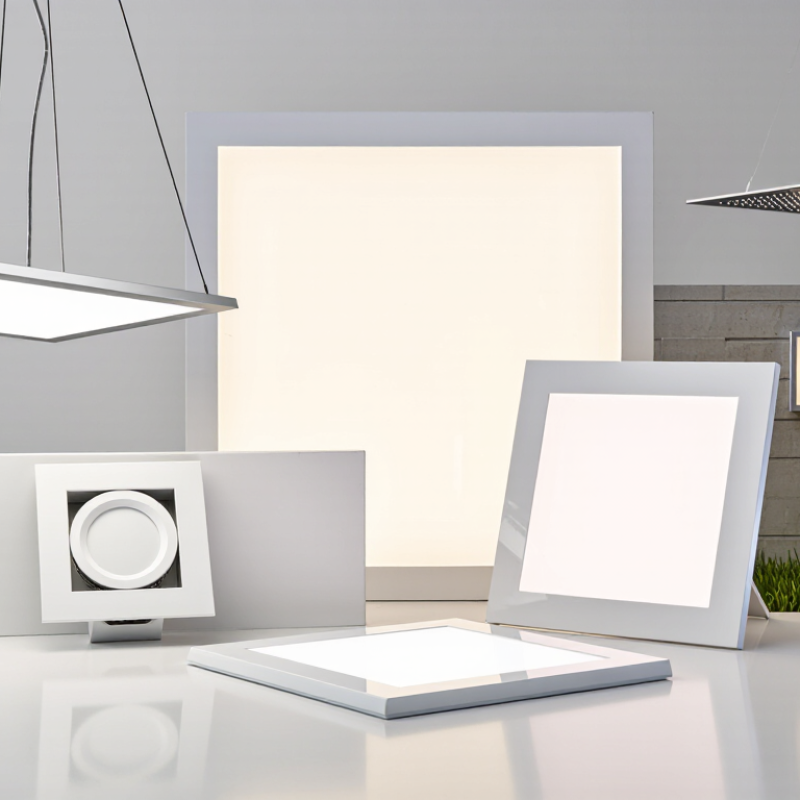
Table of Contents [Hide]
How Square Lights Are Classified by Mounting Type, Optics, and Use
What Are the Top Types of Square Lights?
Square lights are commonly classified by how they mount. Recessed models sit nearly flush with the ceiling, creating a clean look in kitchens or offices. Surface-mounted fixtures attach directly to the ceiling and can suit concrete surfaces where cutting an opening is impractical. Suspended square lights hang lower, often helping define a dining table or reception area. Installation conditions matter: ceiling depth, wiring access, and fixture weight can narrow the choices quickly.
Optics shape how the light feels and performs. Diffused panels spread soft, even light across a work area, while louvered designs help control glare on screens. Some fixtures use directional lenses to focus light on counters or displays. Their square outline does not guarantee even illumination; lens design, mounting height, and room color all affect the result. Classification can overlap, too: one fixture may be recessed, diffused, and designed for offices.
Tips: Measure twice. Check the ceiling opening and available clearance before ordering. For a desk, compare glare and light distribution at seated eye level. A sample may look different in a bright showroom than beneath a low, pale ceiling at home.
Square LED Panels: Compare 600 × 600 mm Formats and lm/W Efficacy
A 600 × 600 mm LED panel is a common square format for offices, classrooms, and other spaces with modular ceiling grids. The size describes the panel format, but the actual body and cutout dimensions can vary. Check the product drawing before ordering. A few millimetres matter.
When comparing panels, look beyond the lumen figure. Efficacy, measured in lumens per watt (lm/W), shows how much light a fitting produces for each watt it uses. For example, a 3,600-lumen panel drawing 36 watts delivers 100 lm/W. Compare figures measured under similar conditions, and check whether the stated power includes the driver. Otherwise, the comparison may be misleading.
Also consider glare control, colour temperature, and light distribution. A bright panel can still feel uncomfortable above a desk if its diffuser creates harsh reflections on a screen. For a fair assessment, compare the same 600 × 600 mm format and similar specifications. Higher efficacy can reduce energy use, but it does not automatically mean better lighting. Room layout matters. So does installation height. One detail is easy to overlook: dimming performance may change at low output, so check it in a real-use setting when possible.
What Are the Top Types of Square Lights? - Square LED Panels: Compare 600 × 600 mm Formats and lm/W Efficacy
| Square-light type | Typical 600 × 600 mm format | Typical input power | Typical light output | Typical efficacy | Common installation and use |
|---|---|---|---|---|---|
| Edge-lit LED panel | Nominal 600 × 600 mm; often about 595 × 595 mm to fit a ceiling grid | 30–40 W | 3,000–4,800 lm | About 100–130 lm/W | Recessed in suspended ceilings; slim construction and broad, even illumination. |
| Back-lit LED panel | Nominal 600 × 600 mm; check the fitting’s actual dimensions before installation | 30–40 W | 3,600–5,000 lm | About 110–140 lm/W | Recessed or surface-mounted; LEDs sit behind the diffuser for direct light distribution. |
| Recessed LED troffer | Designed for a nominal 600 × 600 mm ceiling module | 30–45 W | 3,000–5,000 lm | About 90–125 lm/W | Recessed in grid ceilings; a common choice for offices, schools, and commercial interiors. |
| Surface-mounted square panel | 600 × 600 mm nominal body; mounting frame may increase overall depth or width | 30–45 W | 3,000–5,000 lm | About 90–130 lm/W | Mounted directly to a solid ceiling where a suspended ceiling grid is unavailable. |
| Suspended square LED panel | Usually a 600 × 600 mm panel, suspended using cables or rods | 30–45 W | 3,000–5,000 lm | About 90–130 lm/W | Suspended below the ceiling; useful for high ceilings or where a ceiling-mounted panel is preferred. |
Values are indicative ranges for commonly available LED luminaires, not guarantees for every product. Luminaire efficacy is calculated as delivered lumens divided by input watts; compare figures measured on the same basis. A “600 × 600 mm” panel is often a nominal ceiling-module size, while the actual fitting may be smaller to fit the grid. Check the product datasheet for dimensions, output, power, and efficacy.
Recessed Square Downlights: Assess Beam Angles and CRI 80+ Ratings
What Are the Top Types of Square Lights?
Recessed square downlights sit neatly in the ceiling, but their beam angle affects how a room feels. A narrow beam concentrates light on a kitchen island or artwork. A wider beam spreads illumination across a hallway or living area. For example, a high ceiling may need a narrower beam to keep the light useful at floor level. In a low ceiling, that same beam can create bright patches and dark gaps. Check the fixture’s beam-angle specification, then compare it with the room layout.
CRI 80+ is a sensible baseline for everyday spaces. It helps colors appear more natural than they do under lower-CRI lighting, which matters when choosing clothes or preparing food. Still, CRI alone does not guarantee pleasing color. A painted wall may look different under showroom lighting than it does at home. If color accuracy is important, look for a higher CRI and, where possible, test the light against familiar materials.
Small details matter. Aim square downlights to avoid glare in seating areas, and avoid placing them directly above screens when reflections are likely. Beam charts can make planning seem simpler than it is; furniture, wall color, and ceiling height all affect the result. A quick lighting sketch helps, though it may still need adjustment after installation.
Recessed Square Downlights: Beam Angle Options
These are representative beam-angle options, not specifications for every fixture. Narrower beams concentrate light for accenting, while wider beams spread it across a larger area. Check the product’s photometric data for its actual beam angle, and verify a CRI rating of 80 or higher if accurate color appearance is important. CRI measures color rendering; it is separate from beam angle.
Surface-Mounted Square Lights: Compare 3000–6500 K Color Temperatures
Surface-mounted square lights sit directly against the ceiling, making them practical where a recessed cavity is unavailable. Their color temperature, measured in kelvins, changes how a room feels. It does not indicate brightness. A 3000 K light usually looks warm and slightly golden, while 6500 K appears cool and bluish-white.
In a bedroom or lounge, 3000 K can soften painted walls and make evening reading feel less stark. Check the actual light in the room, though: cream paint may look yellower under warm LEDs. For kitchens, hallways, or work areas, 4000 K often gives a more neutral appearance. It can make white surfaces look clearer without the icy cast some people notice at higher settings. Small details matter. Lens diffusion and the fixture’s color rendering also affect the result.
At 5000–6500 K, square lights produce a crisp, daylight-like tone that may suit utility rooms or focused tasks. In a small room, that cooler light can feel clinical, especially against glossy white tile. Not every ceiling needs it. If a fixture offers adjustable color temperature, test several settings after dark and beside natural daylight; the same setting can look different on each surface. I’d avoid choosing by Kelvin number alone. Compare brightness, glare, and color rendering, too.
Outdoor Square Lights: Select Protection Using IEC 60529 IP Ratings
Square outdoor lights need protection matched to their actual exposure, not just a high number on the packaging. IEC 60529 uses an IP code: the first digit describes protection against solid particles, while the second covers water. An IP44 fitting resists objects larger than 1 millimetre and splashing water from any direction. That may suit a sheltered porch, but not every exposed wall. An IP65 fitting is dust-tight and protected against water jets, making it a stronger option for open, weather-facing areas. Check the installation instructions, too.
IP67-rated housings are dust-tight and tested for temporary immersion under specified conditions. That does not mean every square light can stay underwater or handle every installation. Small details matter. Water can enter through poorly sealed cable glands, damaged gaskets, or incorrect mounting, even when the fixture itself has a suitable rating. It is tempting to choose the highest IP number automatically, but that may solve the wrong problem. Consider rainfall, cleaning methods, nearby sprinklers, and whether the light sits beneath an eave. Also check the complete product’s rating, not just the lamp or housing. If the location is unusually exposed, confirm the manufacturer’s stated installation limits before fitting the light.